
Welcome to another installment on what the heck our family has been up to on our little rock in the South Pacific. A bit delayed this time around, as it hasn’t been smooth sailing these last few weeks. While we’ve had some amazing experiences in the last 6 months, this last month has been overshadowed by some difficulty.
Living Away From First World Luxuries
Last month, our 8 month old island rescue pup Todd was hit by a car in front of our house. It was a Friday evening and we were thankfully home, to hear the aftermath and come to his aid.

For some context, the life of a dog is very different here in American Samoa. I certainly couldn’t have understood all the differences before living here. Dogs run free and create a roaming territory, knowing which dogs belong to which area. If they cross over the invisible line to where they are no longer accepted, the neighboring pack will confront the outsider and attack if he/she doesn’t leave.
Having an indoor only dog isn’t really an option if you want your dog to be accepted. Todd started out as a tiny puppy in the neighborhood, and was able to carve out his spot in the pack without too much trouble.
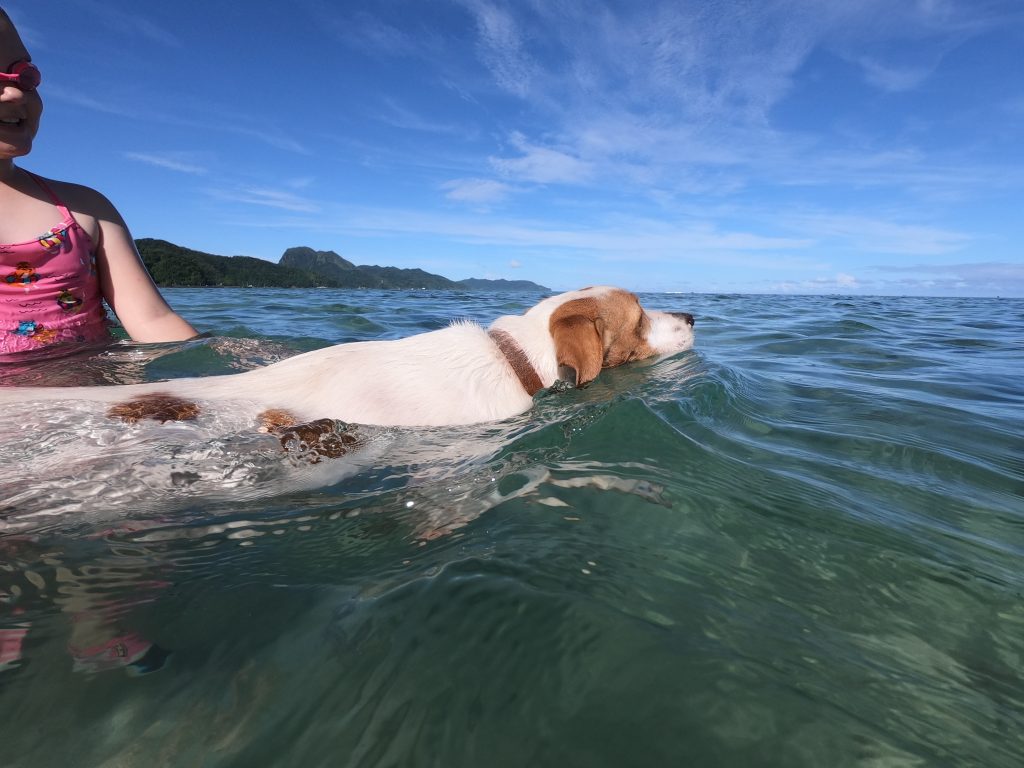
Having come from the US mainland, we didn’t start out with the Samoan approach to dog ownership. Our house has a fenced backyard, but there was no containing Todd. He learned that most fence boards can be pushed out. Rain, ocean spray, and termites have not been kind to our wooden fence. We would fix the fence, then the process would be repeated. If he couldn’t push out then he would dig under, likely laughing at us at the thought of containing an island dog.
It seemed like a happy little dog community at the end of a dead end road. The speed limit is 5 mph and the road is so riddled with potholes it’s difficult to go any faster. Yet people still can drive carelessly, and the energy of Todd’s pack chasing down a truck that night was far too much for Todd to resist joining in.

Todd made it past that first night. We got through the shock, splinted his broken leg, and medicated him thanks to amazing neighbors with dog supplies. Have I mentioned that our island is currently without a vet? The territory vet who was here when we arrived returned to the US mainland a few weeks before Todd’s accident. A replacement won’t be arriving until April.
Thankfully our previous island vet is AMAZING and consulted often with us over the next two weeks. While on the island, she saw hit by car dogs at the clinic everyday, and knew what kind of healing was possible with the limited island resources.
Ultimately, what we originally hoped was swelling in his back turned out to be permanent paralysis. We had to make the terrible decision of euthanizing a big puppy whose body was no longer functioning correctly.

While we are filled with emotions, both sadness and anger, we’re trying to look ahead and create a positive impact from a very unfortunate situation. Our new vet arriving next month will not fix the lack of adequate medical supplies on island, but it will hopefully not leave a handful of critically injured dogs each week having to wait on humane euthanasia options.
A few of us are putting our heads together to make a push for funding/grants towards some larger, necessary items. The vet clinic here works with minimal equipment, and funding is nearly nonexistent. Access to even the most basic supplies is limited.
Coconut Mutts
Help us add a silver lining to our unfortunate experience, and bring about some positive change for animal welfare in American Samoa. Are you able to donate and help? Or spread the word? Coconut Mutts is an established 501 (c) 3 set up to help the animals of American Samoa. There are so many animal welfare details that need to be addressed on the island, but keeping the vet clinic stocked with supplies is critical. Coconut Mutts will use your donations for supplies, and for future programs such as their recent 2018 and 2020 spay/neuter campaigns.
Donate here at Coconut Mutts website.

As for us, everyone is adjusting to the change. Our kids are resilient and no strangers to saying good-bye to a pet. Life marches on so quickly, and they’re swept up in the everyday life that always seems to fly by. They were spared from the decision making, and it’s the doubt of that decision that is the hardest to digest.
There are no veterinary diagnostic tools on island to completely confirm what we suspected was going on under his skin. For two weeks we constantly scanned for any small physical change that indicated healing. It was overwhelming. It’s a blend of guilt and relief those two weeks are over.
Catch Up
Curious to learn more about our time in American Samoa? Follow along by reading our Living in American Samoa series.

Thank goodness, Mer, that you have some vet tech experience. I feel for those on the island that are like me … petrified when a pet is sick, not knowing what on earth to do … to call … not to call. Not having anyone to call is so hard to believe. You know the first thing I do is call “Dr.” Pilon and she is always good for advice. So sorry to hear this. love, Kathy
Thanks Kathy. When Beth heard we might not even be able to find a way to euthanize she suggested I ask Dr. Pilon to send meds! So you’re not the only one who thinks of her. Was definitely thankful for experience in the clinic and at the farm. Not sure I could have made it past that first night otherwise. A crummy experience, but hoping to help out other 4 leggeds moving forward. xoxo
I am so sorry to hear that. We noticed throughout the South Pacific how little veterinary care is available. It is very sad. 🙁
Sad indeed. I read this and feel so lucky we had some access to veterinary knowledge at least, with a vet on the way. The South Pacific islands are so remote, making it so hard to access medications. If the islands are without a vet, then animal populations explode.